Showing posts with label Hope. Show all posts

Sunday, February 16, 2014

Dignity


Dignity - from the latin word dignus meaning "worthy."

Is dignity something that people have that we are supposed to recognize in them? Or is it something that we bestow upon one another regardless of their race, age, socioeconomic class, etc?

We talk about dignity as this thing that you are supposed to have for yourself. And sometimes because of the way that you behave and/or the status that you have, people might treat you with it. But essentially this means that you kind-of have to be on the top of your emotional, positively self-visuallizing game to "have" dignity.

Let's say you have had a fever and been vomiting all day, or you have been up for three days with your child, or you are having a tumor removed after a few months of chemotherapy, or a tsunami just destroyed your entire city. Just saying - in the midst of these trying situations we do not exude anything resembling some kind of intrinsic dignity.

This is one of the things I love about being part of the health care world (human race, dare I say?). No matter who you are, or what you have accomplished with your life or how long you have been overlooked on the street corner and no mater what kind of train wreck you are experiencing right now - Sometimes you just can not muster up much dignity for yourself. A comfortable bed, a bite to eat, a new leg, reconstructive surgery, a room where no one can see you falling to pieces over the news you just received.  Regardless of status, rank, salary or just how sure of yourself you are feeling that day, it is our privilege to bestow dignity.

Thursday, March 11, 2010

Around the Dinner Table

The best of generosity inspires future generosity - not the repayment of generosity.

Monday, March 1, 2010

Application Update

As things stand:

The perverbial ball is in their court.

VCOM has already decided that, though I was qualified, I didn't not rate high enough in their applicant pool and said "not this year. But, hey! try our post-bacc program."

WVSOM has me on deferred status. As today is March first and it has been about a month since they received the final parts of my application and pretty much everyone who is going to apply has to have applied by now, they may be revisiting me as a potential D.O. candidate.

PCOM will be opening the final part of my application package today (which I've had almost three months to get together - more on procrastination later). Their application deadline was also today. So, again, all who will be applying have applied. If they still have any of the 250 spots available for 2010, I am in the running for one. Besides a couple of glowing letters of recommendation and a review of my transcripts (which they saw before they asked me to continue applying) they will read this:

________________________

Every person has a story. Going from patient to patient as a volunteer in the emergency room I have heard many stories that involve significant suffering. That need for hope and cry for help compels me to take action. People want to feel that their stories are valid. If a few minutes of compassionate listening can begin to plant the seeds of hope, how much more powerful when combined with medical care and health education. A hopeful patient will get well, but they can not always initiate that hope on their own.

I believe that the world can be more vibrant and healthy than it is now. I also believe that I can play an instrumental role in improving it. I have faith that by continuing to do my best to elevate the lives of those around me the world will become a better place. I am convinced that my greatest ambition is to continue pursuing health care. From my first semester of college I have been directing myself such that I am able to relate to all kinds of people, understand health and disease and integrate myself into the medical field. I soak up new ideas and personal stories like a sponge. The more I assimilate, the more I am compelled to climb higher and continue my quest to restore health and hope. Medical school is the next step for me on that journey.

I must continue climbing. As a child I wanted to know everything but I quickly learned that the wealth of knowledge before me was vast, and I could achieve more if I focused my attention on one field. To me, physicians have the most useful training and abilities. The knowledge they hold and authority they possess are combined to improve the health and wellness of their patients. Because of my dedication to renewing the hope and health of others, my fullest potential would be realized as an osteopathic physician.

In my quest for knowledge, I seek the very best. I believe that you have the best program in the country. My mentor, Dr. Stephen Restaino, is a graduate of PCOM. It is stated on your web site that in your curriculum you emphasize looking "beyond the person in front of you and discovering the social and economic factors that impact him or her." I have seen firsthand how that priority in his education has continued to shape Dr. Restaino's approach to medicine for the past twenty nine years. I want that same emphasis in my own medical education. I realize that many osteopathic programs are established in rural, small town environments. While the countryside is where my roots are and a noble place to practice medicine I believe that a metropolis is more conducive to education. I thrive in an urban environment and I believe that for access to diversity and information there is no better place than the city.

I can not wish the world into a better place. But with the skills, knowledge and authority that I am hungry for I can work to improve health and give hope to many people.
________________

So here's to the right people taking my application seriously. Being compelled by the taste they are starting to get of who I might be that they must invite me for an interview to see me for themselves. Not that I'm some spectacle or too good to be true, but because they realize that I am ready for success and they can play a part in that and there by allow a little more compassion to flow out into the world.


Thursday, November 12, 2009

Five Qualities (open for critique)

Family – Love, humor, responsibility. I am the oldest of six siblings. I am a husband and a brother-in-law. I am a classmate, a teammate, and a roommate. I have many good friends and I am a good friend to many. I attended birthdays, weddings, commencements, graduations, funerals, and cookouts. I actively instill an almost tangible quality into every relationship in which I engage to the point that walking into class feels like a family reunion.

Athleticism – Energy, creativity, team building. I have participated in athletic activities since I was a child. I believe in physical fitness for training the build up and release of energy in both athletic and professional activities. I love to employ improvisation in group sports like soccer, and also to create new games to allow a playful free thinking approach to challenges. Team sports cultivate communication and interdependence that translates easily to a professional and/or academic setting where we must rely on and support our peers.

Ingenuity – Courage, dedication, initiative. I have a knack for appreciating the mission of an organization and finding ways to improve it. In the Religious Studies department at UVA, I founded a peer mentorship program to help make newcomers feel more included and well oriented. At Rosetta Stone I developed new sales techniques. Growing up on a farm, I planted potatoes in old tire treads to increase warmth and retention of nutrients.

Stamina – Vigilance, perseverance, faith. From supporting myself through college, to riding my bicycle everywhere I go, to working three part time jobs at once, to entering long distance foot races - I take on more than seems possible and exhibit stamina in finishing what I start no matter how tough it gets.

Inspiration – Hope. I discover inspiration in many places – the pages of National Geographic Magazine, watching Olympic athletes, listening to a pediatrician give wellness advice to his patients. Many people continue to put hope, faith and love into me because I have a tremendous capacity to receive inspiration and use it to make their world a little better. In return, I seek through both example and guidance to inspire those around me by supporting my peers and kindling the fire in rising generations.

Wednesday, July 29, 2009

stick it on with soap

When I am a doctor I am so going to take enthusiastic young students under my wing as they apply to and transition into medical school. I'm going to go out and find them. It won't be any secret that spending time with Casey Turner will help you find out about being a physician and getting into medical school. They'll all know that I'll encourage them and challenge them and even tell them where they need to improve.

Now, where the hell is my Casey Turner!

Wednesday, March 4, 2009

Discovery - Primary Care Research

Journals are an important part of the medical profession (and really any profession that seeks to grow through mutual collaboration and accountability). There are many medical journals and each has their own flavor and a different set of standards which must be met to have your research or commentary published in the journal. This is excellent. In one way it is as great as having different channels on television (only generally more educational) - tune into the ones you want, DVR the rest for a rainy day. The myriad venues for publication also leaves any ambitious professional with the sense that there IS a place to share their original thoughts and to make connections where original seeds can be synthesised into great accomplishments thus furthering the scope and the efficacy of the healing arts. I hope to make many such contributions in the future.

I am sure to do intro blogs on many journals and later on I may put the spot light on some specific articles that I find particularly compelling. For today I would like to shine the light on the journal for Osteopathic Medicine and Primary Care. They are self described as

"an open access, peer-reviewed online journal that encompasses all aspects of family medicine, internal medicine, pediatrics, and obstetrics and gynecology. The journal also covers health service and public health research that addresses primary care."

Things I found noteworthy on first glance:

  • Access to all of their articles is free. Many (I believe most) journals put a significant amount of energy into the organization and lay out of a print version of their publication. OM-PC is an exclusively electronic publication and through placement of...well semi relevant ads on their website is able to provide it for free. Worth the giant pfizer banner across the top of the screen? I think so.
  • They are based out of Ft Worth and have what seems to be a strong relationship with the University of North Texas Health Science Center (Which on a side note is quickly becoming one of my top picks for schools). The Editor In Chief of the journal I believe also teaches at UNT-HSC.
  • To post an article a relatively standard procedure of peer review and resubmittal is done, but on the whole they keep their publication time very low. (months compared to years)
  • Publication in the journal makes your research searchable (and findable) on not only PubMed (the largest and most popular bibliographical search engine) but four others as well.
  • Besides these great features I just really appreciate that they are providing a venue for and thus encouraging exploration in the field of primary care (with specially attention to Osteopathy). This is a field that has been seeing decline in recent years due to the increasing disparity between that field and more specialized fields. This decline may in part be due to the relatively slow pace of research and improvement as compared to that of the subspecialties. This article in particular gave me great hope.

Monday, March 2, 2009

Necessary Angels

As I work towards entering a career in medicine I am sometimes overwhelmed by the incredible barriers to entry. Where, after working so hard to be trained to save lives and help people improve their health I can still only help one person at a time. I would like to think that I could get a better rate of return. Or more acurately, I would like to think that I could invest myself in a way that would have a profound ripple effect, helping to improve the lives of more people than the one person I can treat at a time.

I found
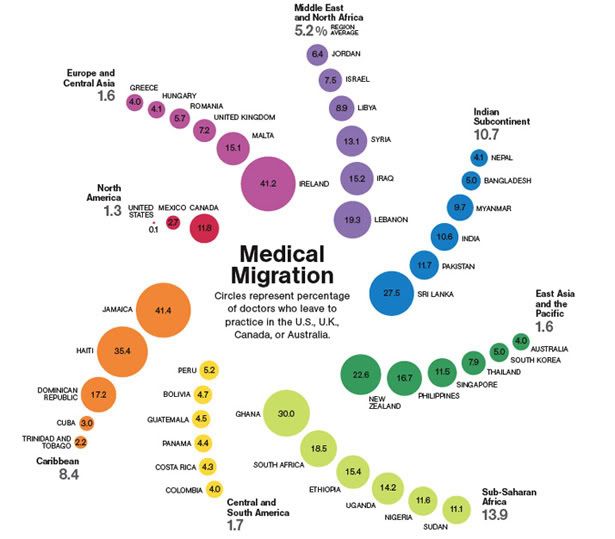
this article while I was reading the December 2008 issue of National Geographic (NGS). I was left feeling very hopeful and inspired for the future of health-care in the world. I believe it is accurate that every country in the world has a shortage of providers, especially primary care providers. The idea of the world being short by 2.3 million physicians, nurses and midwives (according to this this WHO study) makes a prospective physician pretty sure that he'll have something to do in the future. Unfortunately, according to this same study, the economic demand for health care providers will be almost satisfied by 2015. Oh! don't get me wrong. We'll only be scratching the surface of those 2.3M needed providers. But even the providers who are trained in the countries that need them leave those under served areas to seek employment in wealthier areas that can provide them with a better comfort to skill ratio. The illustration below was pulled from this follow up article in NGS.


brain drain
True, even the US has a need based shortage of providers right now, and we seem to have money to pay them - not only to pay them but to retain them. We have an amazing system set up to provide incentive to emerging physicians to focus on primary health care and to practice it (at least for a time) in an under served area of the U.S. This is fantastic. But what about say Ghana, or any of the other 30 odd countries that are predicted to still have major deficits in health care provision long into the foreseeable future. Illustrated above are 45 different physician producing nations, many of which still have major deficits in health-care provision. Doctors want to get paid!

I almost hate to say it. But it's unfortunate that physicians have to be paid so much. The financial barriers to entry, the ever ominous malpractice nightmare and the growing expense (in more developed countries) of technological standards in medicine drive the cost up and up. Not to mention that spending 11+ years after high school making zilch dough to endure what is un-arguably one of the most grueling secondary educational experiences in the world leaves many doctors with an overdeveloped sense of entitlement and very little energy or patience to do anything but maximize their comfort to skill ratio. Compound that with the growing case that most doctors and nurses (especially specialists) are trained to work in/with high tech developed facilities where even if they wanted to go work for pennies in a place that needed them more they would be up sh** creek without a paddle.

As a doctor there are a few key procedural skills that I would feel naked without in any country, any specialty, at any time of day: performing topical sutures, removing bullets, and delivering babies. Personally I have had more stitches than babies. But I hear babies are pretty common. Fortunately, delivering a baby is one medical procedure that it is not overly difficult to train a "lay person" how to do (including training them to know when they are in over their head). This brings me back to the hope. The example that was illustrated in the Necessary Angels article showed me that so SO much could be done for un(der) developed countries to fill in the need for much health care without having to export millions of physicians to those countries. In developed countries people are at risk to die from things that mostly take highly trained physicians/practitioners to remedy. In un(der) developed countries people die from things that could be reduced by education and sanitation. What
Raj Arole
demonstrated in Jamked was that: 1) a passionate lay person can be moderately trained to administer rudimentary primary care and to educate their community, and that 2) a little bit of attention from a moderately trained lay person can make a serious impact in improving the quality of life in underdeveloped areas. Instead of proposing that a way be found to educate doctors "for free," I would argue that it would not only be more efficient, but possibly even more effective to provide funding for and train a handful of the members in underdeveloped communities to provide the kind of care that we see in Jamked.

I like to get more than a 1:1 return on my investments. This story of passionate women and physicians in India gives me hope that as a doctor I will not just be buying into a great tragedy of the information age. I hope that one day in a world far from the one I live in now I may be helping to implement health-care for more than just one person at a time.